
Golf Club Management
Lesson 2: Governance, management and organisational structure
Goal: distinguish governance from management, explain the main theories of what boards are for, and evaluate a club’s structure using organisation design concepts.
Governance is not management
The simplest working definition: governance decides where the club is going and checks that it’s getting there; management decides how to get there and does the work. The King V Code on Corporate Governance (IoDSA, 2025), which applies to non-profit organisations as well as companies, puts it as the governing body setting direction, approving policy and planning, overseeing and monitoring, and ensuring accountability, while delegating the running of the organisation to management through a clear delegation framework.
In practice the line is blurred, and golf clubs blur it more than most. A board of volunteer members, many of whom ran businesses themselves, sits two floors above the operation they use every week. When the greens are slow, a director can see the problem from the first tee. The temptation to fix it directly is strong.
Sport governance research describes the same pattern in member-based sport organisations. Boards drift into operational detail, and the board and the CEO work out their roles person by person, not from written rules (Ferkins, Shilbury and McDonald, 2005; Shilbury, Ferkins and Smythe, 2013). The usual first fix is a board charter that sets out the boundary between governance and management, and a board that holds to it.
What is a board for? Four theories
Each theory gives a different answer, and each one leads to a different kind of board.
| Theory | The board’s main job | Implication for a golf club |
|---|---|---|
| Agency theory (Jensen and Meckling, 1976) | Monitor managers, whose interests may differ from the owners’ | Independent directors, audit committee, strong financial controls over the GM |
| Stewardship theory (Donaldson and Davis, 1991) | Support and empower managers, who are assumed to want to do a good job | A trusting partnership with the GM; less monitoring, more coaching |
| Resource dependence theory (Hillman and Dalziel, 2003) | Bring in resources: skills, networks, legitimacy, money | Skills-based recruitment (a lawyer, an accountant, someone who knows hospitality or turf) |
| Stakeholder and democratic perspectives (Cornforth, 2004) | Represent the members, who elect it | Directors elected for popularity or length of membership, not for skills |
Cornforth argues that in member organisations these pull against each other, and that a good board manages the tension and doesn’t choose one side. A golf club board must be democratic (members elect it) but also expert enough to oversee a multi-million dollar business, and both controlling and supportive of the GM.
Evidence: mixed evidence. Hillman and Dalziel (2003) is widely cited for combining agency and resource views. Research linking board make-up to organisational performance is inconsistent, partly because “performance” is hard to measure in non-profits.
Sport governance research
Sport management researchers have studied boards in sport organisations closely, and their findings transfer well to golf clubs:
- Ferkins, Shilbury and McDonald (2005) and Ferkins and Shilbury (2012) show that good sport boards are strategic: they co-lead strategy with management rather than either rubber-stamping it or doing it themselves. The board-CEO relationship is the central ingredient.
- Shilbury, Ferkins and Smythe (2013) found that in practice the boundary is negotiated person by person, with trust and relationships mattering as much as written policy.
- Shilbury’s (2017) chapter on golf governance applies this work to golf’s peculiar structure of national bodies, provincial or regional unions and member clubs. In South Africa that is GolfRSA, the provincial golf unions and the clubs.
- Kikulis, Slack and Hinings (1992) describe three design archetypes that sport organisations move through. A kitchen table organisation is run by volunteers, with few rules. In a boardroom organisation volunteers set policy through committees and a few staff carry it out. An executive office has professional staff running operations under a policy board. Many golf clubs are part-way between boardroom and executive office, which is exactly where the confusion about roles lives.
The constitution and the committees
The constitution is the club’s founding rulebook. It sets out membership categories and voting rights, how directors are elected and for how long, the board’s powers, how general meetings work, and how the constitution itself can be changed (usually a special resolution needing 75% of votes cast). For an NPC, the Companies Act 71 of 2008 and the MOI set these rules, and the Act imposes duties on directors (to act in good faith, for a proper purpose and with care, skill and diligence) whatever the MOI says. For a voluntary association, the constitution is the only rulebook, so a vague or outdated one leaves the club exposed in any dispute.
Clubs typically have committees as well as the board. They fall into two kinds:
- Board committees (finance and audit, risk, nominations, governance) help the board govern. They should have a written charter, report to the board, and not direct staff.
- Operational committees (match, greens, house, women’s, juniors) are often a hangover from the boardroom archetype, when volunteers did the work. Where a club has professional staff, these committees should advise management, not instruct staff. Many clubs have converted them into advisory or member-liaison groups.
A board charter, a written delegation of authority to the GM and a charter for each committee are among the quickest ways to fix a role-confusion problem. King V and its guidance for non-profit organisations describe what they should cover, and CMASA can supply examples from other clubs.
Organisational structure
Structure is how work is divided up and then co-ordinated. Mintzberg’s (1980) “structure in fives” describes five basic ways organisations co-ordinate work: direct supervision, standardised work (SOPs), standardised outputs (targets), standardised skills (professionals) and mutual adjustment (people talking to each other).
A golf club is usually a functional structure: departments by specialism (course, golf, food and beverage, administration). Functional structures are efficient and build expertise, but they create silos when each department optimises for itself. The greens crew closes a nine for maintenance on the morning golf operations has sold to a corporate group; the kitchen finds out about the field size for the presentation dinner from a member. The fixes are co-ordination mechanisms, not new boxes on the chart: a weekly operations meeting, a shared events calendar in the club management system, joint KPIs and a GM who owns cross-department problems.
In the clubhouse
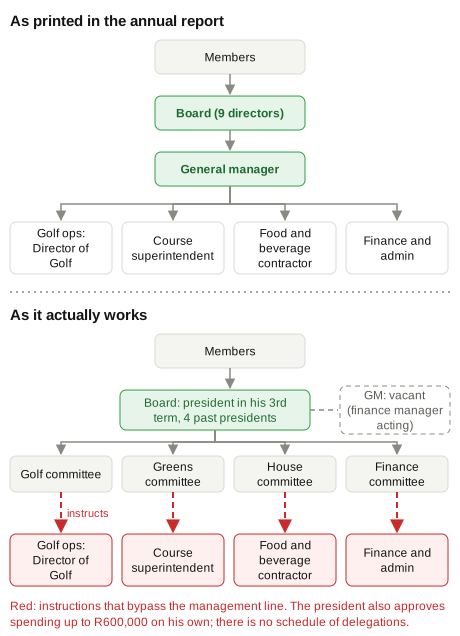
A common case: the greens committee chair, an elected director, meets the course superintendent every Monday and agrees the week’s work. The GM isn’t there. When the course is closed for a tournament preparation without warning to golf operations, the GM is blamed by members but had no say. Under agency theory the board has failed to hold management accountable; under the archetype model the club is stuck halfway to executive office; under Mintzberg it relies on direct supervision from outside the management line. All three lenses point to the same fix: the committee becomes advisory, the superintendent reports to the GM, and the board sets the course standards it wants and monitors them.
Critical view
- “Stay out of operations” can be overdone. In small clubs with one or two staff, directors have to do some operational work. The archetype model reminds you that structure should fit the club’s stage.
- Governance codes (King V, and the King IV supplement for non-profits before it) are practitioner frameworks. They are built on consensus about good practice, not on evidence that following them improves results.
- Governance has a diversity dimension too. In South Africa, that includes race as well as gender: GolfRSA’s Transformation Charter set representivity targets for executive structures, and its Women in Golf Charter commits clubs to more women in leadership. A board that doesn’t look like its future membership may struggle to plan for it.
Seminar questions
- Which board theory best describes your club’s board today? Which one should it move towards, and why?
- Using Kikulis et al.’s archetypes, where is your club? What would moving to the next archetype cost, and who would resist?
- Is an elected, member-based board compatible with skills-based recruitment? How do clubs combine the two (appointed directors, nominations committees, skills matrices)?
Workplace task 2
Take the organisation chart from Workplace task 1. For each line where a director or committee deals directly with staff, classify it as governance (setting policy, monitoring) or management (giving instructions). Then find your club’s constitution clause on the board’s powers and check whether it allows delegation to a GM. Write a half-page note on what you found.
Watch
- What’s the difference between a working and governing nonprofit board? (Funding For Good)
Sources
- Cornforth (2004), The governance of cooperatives and mutual associations: a paradox perspective, Annals of Public and Cooperative Economics
- Donaldson and Davis (1991), Stewardship theory or agency theory, Australian Journal of Management
- Ferkins, Shilbury and McDonald (2005), The role of the board in building strategic capability, Sport Management Review
- Ferkins and Shilbury (2012), Good boards are strategic: what does that mean for sport governance?, Journal of Sport Management
- Hillman and Dalziel (2003), Boards of directors and firm performance, Academy of Management Review
- Jensen and Meckling (1976), Theory of the firm, Journal of Financial Economics
- Kikulis, Slack and Hinings (1992), Institutionally specific design archetypes, International Review for the Sociology of Sport
- Mintzberg (1980), Structure in 5’s, Management Science
- Shilbury, Ferkins and Smythe (2013), Sport governance encounters, Sport Management Review
- Shilbury (2017), Golf governance, in Golf Business and Management, Routledge
- IoDSA (2025), King V Code on Corporate Governance; see also the King IV NPO sector supplement
- GolfRSA (2019), Transformation Charter 2019 to 2023; Women in Golf Charter
Draft module material for the PGA of South Africa Director of Golf certificate, for discussion. South African law applies throughout. It is general education, not legal or financial advice: Acts, regulations and codes change, so check the current version and take advice before acting on them.