
Golf Club Management
Lesson 9: Business systems, processes, SOPs and controls
Goal: map and improve a club process, write a standard operating procedure, and design the controls that keep a system reliable.
Systems thinking
A system is a set of connected processes, people, technology and rules that produces a result. A golf club runs dozens: the tee booking system, the competition and handicap system, membership (enquiry to joining to renewal to resignation), the event and function system, purchasing and accounts payable, payroll and rostering, course maintenance scheduling, stock control and the complaints system.
When service is inconsistent, the cause is usually the system, not the individual. Deming’s often-quoted estimate was that the great majority of problems (he said 94%) belong to the system, which only management can change. Popular claim: the exact figure was Deming’s judgement, not a measured result, but the principle underpins all quality management.
Policy, procedure, SOP
These terms are often confused:
| What it is | Who approves | Example | |
|---|---|---|---|
| Policy | A rule or principle: what and why | Board | “The club will provide a safe workplace and comply with OHS law.” |
| Procedure | The steps to carry out a policy: who does what | GM | “Incidents are reported to the duty manager within one hour and logged in the incident register.” |
| SOP (standard operating procedure) | Detailed, task-level instructions | Department head | “Closing the bar: 12 steps from last drinks call to alarm set.” |
| Work instruction / checklist | The one-page tool used on the job | Department head | The bar closing checklist on the wall |
Boards approve policy, management writes procedures. A board writing SOPs, or a GM making policy without the board, is a governance problem (Lesson 2).
Mapping a process
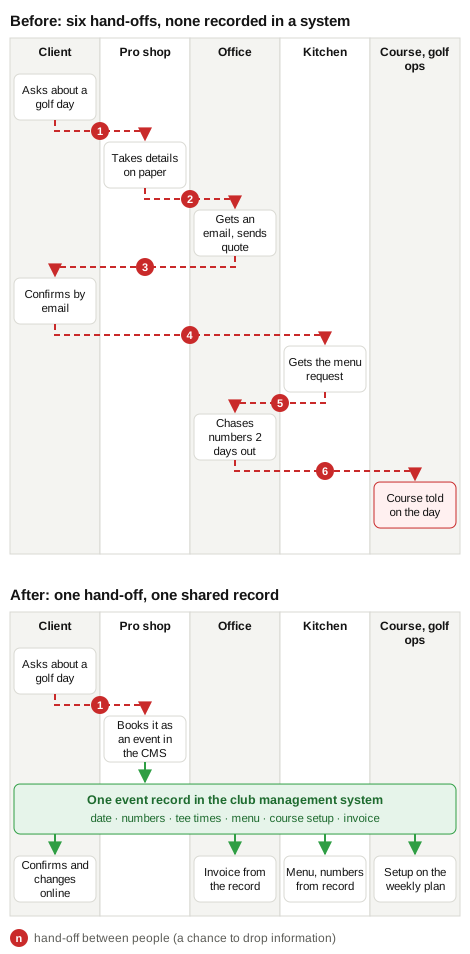
Before improving a process, draw it. A swimlane map shows each step in a lane for whoever does it (member, pro shop, office, kitchen, system). It immediately shows hand-offs, delays, double handling and the points where information drops between departments.
Example: booking a corporate golf day. The member calls the pro shop, the pro shop emails the office, the office emails the kitchen, the kitchen confirms numbers two days before, golf operations sets the draw, the course superintendent hears about it on the day. Each hand-off is a chance to fail. The improved process puts the event into the club management system once, and every department sees it there.
Developing a system: a simple method
- Define the outcome and the customer. What does good look like, and for whom?
- Map the current process with the people who do it.
- Find the waste and the failure points. Lean thinking (Womack and Jones, 1996) names the classic wastes: waiting, rework, unnecessary movement, over-processing, excess stock, defects and unused talent.
- Design the new process, with as few hand-offs as possible.
- Write the SOP and checklist.
- Train, test, then roll out.
- Measure and review.
Writing an SOP that people use
- One task per SOP, with a title that says what it is.
- Purpose, scope, who is responsible.
- Numbered steps, starting with a verb. One action per step.
- Photos or screenshots for anything visual (where the shut-off valve is).
- The safety and legal points flagged (RSA requirements, chemical handling).
- A version number, an owner and a review date.
Test it by giving it to a new casual staff member. If they can’t follow it without asking questions, rewrite it.
Controls
Controls make sure processes give reliable, honest results. The COSO Internal Control Framework (2013) groups them into five components: the control environment (tone from the top), risk assessment, control activities, information and communication, and monitoring. Typical club controls:
- Segregation of duties: the person who approves an invoice doesn’t pay it.
- Delegations of authority: a written schedule of who can spend or commit how much (department heads to R40,000, GM to R400,000, board above).
- Reconciliations: daily till reconciliations, monthly bank and stock reconciliations.
- Access controls: system log-ins, so that each person’s actions are traceable.
- Exception reports: voids, discounts and complimentary items reported to the GM weekly.
Small clubs struggle with segregation because they have few staff. Compensating controls include board review of monthly transactions and a second signatory on payments.
Continuous improvement
PDCA (Plan, Do, Check, Act), popularised by Deming, is the basic improvement cycle: plan a change, try it on a small scale, check the results against data, then adopt, adapt or abandon. Bhuiyan and Baghel (2005) trace continuous improvement from early suggestion schemes through total quality management, lean and Six Sigma. Bessant, Caffyn and Gallagher (2001) show that organisations develop continuous improvement capability in stages, from occasional problem-solving to a habit embedded across the organisation. Evidence: some evidence. Results depend heavily on management commitment and on staff involvement.
Critical view
- SOPs can kill judgement. Hospitality needs staff who can read a member’s mood, not just follow a script. Standardise the things that must be the same every time (safety, cash, legal) and leave room for service.
- Lean came from car manufacturing. Service settings can benefit, but members are not cars on a production line, and “efficiency” can come at the cost of warmth.
Seminar questions
- Which club process has the most hand-offs between departments? What would happen if one department owned it end to end?
- When should a club write an SOP, and when should it trust staff judgement?
- How can a small club with five staff maintain segregation of duties?
Workplace task 9
Map one cross-department process at your club as a swimlane diagram. Mark every hand-off and every delay. Then write the SOP for the most error-prone step, and test it on a colleague.
Watch
- PDCA cycle explained (EPM)
Sources
- Bessant, Caffyn and Gallagher (2001), An evolutionary model of continuous improvement behaviour, Technovation
- Bhuiyan and Baghel (2005), An overview of continuous improvement: from the past to the present, Management Decision
- COSO (2013), Internal Control: Integrated Framework
- Deming (1986), Out of the Crisis, MIT Press
- Hammer (1990), Reengineering work: don’t automate, obliterate, Harvard Business Review
- Womack and Jones (1996), Lean Thinking, Simon and Schuster
Draft module material for the PGA of South Africa Director of Golf certificate, for discussion. South African law applies throughout. It is general education, not legal or financial advice: Acts, regulations and codes change, so check the current version and take advice before acting on them.