
Golf Club Management
Lesson 3: Vision, mission, values and strategic direction
Goal: write or critique a club’s vision, mission and values, and explain how they sit at the top of a planning hierarchy that ends in weekly tasks.
The planning hierarchy
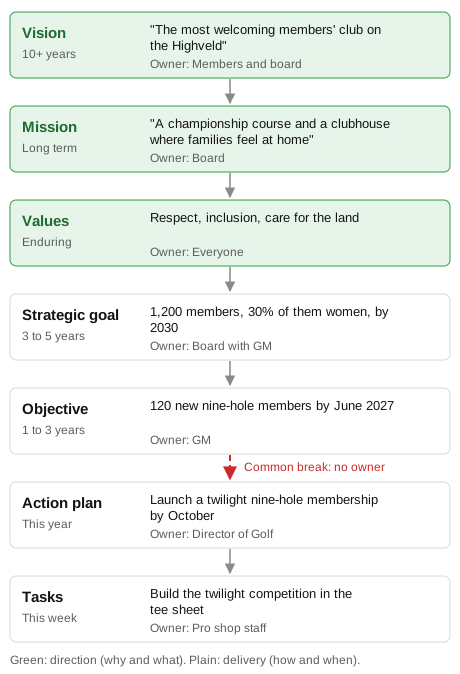
Strategy textbooks (Johnson et al., Exploring Strategy) describe a cascade, each level answering a narrower question:
| Level | Question | Golf club example | Time frame | Owned by |
|---|---|---|---|---|
| Purpose / vision | Why do we exist, and what do we want to become? | “The most welcoming members’ golf club on the Highveld” | 10+ years | Members and board |
| Mission | What do we do, for whom? | “A championship-standard course and a clubhouse where members, families and guests feel at home” | Long term | Board |
| Values | How do we behave while doing it? | Respect, inclusion, care for the land | Enduring | Everyone |
| Strategic goals | What must be true in 3 to 5 years? | Membership 1,200 with 30% women; clubhouse refurbished debt-free | 3 to 5 years | Board with GM |
| Objectives / KPIs | How will we know? | Member satisfaction 8/10; course closed under 10 days a year | 1 to 3 years | GM |
| Tactical and action plans | What will each department do this year? | Golf operations: launch a nine-hole twilight membership by October | 1 year | Department heads |
| Tasks | Who does what this week? | Build the twilight competition in the tee sheet; brief the pro shop staff | Weeks | Staff |
The GB&I PGA material already makes the link from strategy to tactical and action plans. At university level, you should be able to show the whole chain for a real club and spot where it breaks. A common break is a strategic goal that has no owner and no action plan beneath it.
Vision and mission
Collins and Porras (1996) split a useful vision into two parts. The core ideology (core purpose plus core values) shouldn’t change. The envisioned future is a bold 10 to 30 year goal plus a vivid description of what achieving it would look like. Their argument was that enduring organisations preserve the core and change everything else.
Sinek’s “start with why” (2009) made a similar point for a popular audience: people commit to why an organisation exists more than to what it sells. For a members’ club this has real force. Members join for belonging and identity as much as for the course.
Evidence: some evidence. Bart and Baetz (1998) found only a weak, inconsistent link between having a mission statement and financial performance in Canadian firms, but a stronger link where the mission was well written, widely known and used to make decisions. The statement itself does very little. What makes the difference is whether people use it.
Values that are real
Values matter at a golf club because they settle arguments before they start: about dress codes, about women’s tee times, about a member who abuses staff. A useful test from Lencioni (2002) separates:
- Core values: the behaviours the club will hold to even when it costs something (it will sanction a long-standing member for abusing staff).
- Aspirational values: what the club wants to be but isn’t yet (genuinely inclusive).
- Permission-to-play values: the minimum standards everyone expects (honesty, safety).
Calling an aspirational value a core value is how clubs end up with a values poster that staff quietly laugh at. Lesson 7 shows why: Schein’s research found that what people actually do (underlying assumptions) overrides what is written (espoused values).
Strategic direction for a members’ club
A club’s broad strategic choices usually come down to a few questions:
- Who is the club for? Traditional full members, families, juniors, social members, visitors, corporate events, or some mix?
- What will we be known for? Course quality, championship hosting, social atmosphere, value for money, coaching and pathways.
- How will we fund it? Subscriptions, entrance fees, green fees, hospitality, functions, sponsorship, debt, or property assets?
- What won’t we do? Porter’s (1996) line that “the essence of strategy is choosing what not to do” is hard for member clubs, because every group of members wants their thing protected.
In the clubhouse
Many clubs’ strategic plans have a vision on page one and a list of projects on page ten with nothing joining them. A strong plan makes the line visible: the vision says “welcoming to families”, a goal sets a junior and family membership target, an objective defines the measure, and the golf operations action plan includes a junior pathway with a named owner and a budget. If you can’t trace a project back up to the vision, ask why the club is doing it.
Critical view
- Mission statements are often written by consultants in a workshop and then forgotten. Treat the statement as evidence of intent, not of practice.
- Collins and Porras built their argument from a sample of companies chosen because they had survived. That is survivorship bias: firms that had strong ideologies and failed were never in the sample.
- Mintzberg (Lesson 5) would add that much real strategy emerges from what the club does, not from what the plan says.
Seminar questions
- Should a members’ club have a “bold” vision at all, or is preserving what members already love the right strategy?
- Pick one value from a real club’s website. Is it core, aspirational or permission-to-play? What evidence would tell you?
- Who should have the final say on a club’s vision: the board, the members at a general meeting, or management?
Workplace task 3
Using your club’s strategic plan (or annual report), fill in the planning hierarchy table above for one strategic goal, from vision down to this month’s tasks. Mark any level that is missing or that has no named owner.
Watch
- How great leaders inspire action (Simon Sinek, TED)
Sources
- Bart and Baetz (1998), The relationship between mission statements and firm performance, Journal of Management Studies
- Collins and Porras (1996), Building your company’s vision, Harvard Business Review
- Johnson, Whittington, Regnér, Angwin and Scholes (2020), Exploring Strategy, 12th edition, Pearson
- Lencioni (2002), Make your values mean something, Harvard Business Review
- Porter (1996), What is strategy?, Harvard Business Review
- Sinek (2009), Start with Why, Portfolio
Draft module material for the PGA of South Africa Director of Golf certificate, for discussion. South African law applies throughout. It is general education, not legal or financial advice: Acts, regulations and codes change, so check the current version and take advice before acting on them.