
Golf Club Management
Lesson 7: Understanding club culture
Goal: diagnose a golf club’s culture with recognised models, and explain how culture shapes, and often blocks, future plans.
What culture is
Schein (2010) defines culture as the pattern of shared basic assumptions a group has learned while solving its problems, which has worked well enough to be taught to new members as “the way we do things here”. He describes three levels:
- Artefacts: what you can see and hear. The honour boards, the dress code sign, who sits where in the bar, the order of the Saturday field, how staff are spoken to.
- Espoused values: what the club says it believes. The values statement, the strategic plan, the president’s report.
- Basic underlying assumptions: the taken-for-granted beliefs underneath. “Saturday morning belongs to the A-grade men.” “Staff are here to serve members, not to have opinions.” “Change is what’s done to us by the board.”
The levels often disagree. A club whose espoused value is “inclusion” but whose artefacts include a women’s tee time of Tuesday 7 am only, is telling you its real assumptions. When values and assumptions conflict, assumptions win.
The Competing Values Framework
Cameron and Quinn (2011) map culture on two dimensions: internal versus external focus, and flexibility versus stability. Together they give four culture types:
| Flexibility | Stability | |
|---|---|---|
| Internal focus | Clan: family-like, loyalty, tradition, mentoring | Hierarchy: rules, procedures, efficiency, control |
| External focus | Adhocracy: innovation, risk-taking, new ideas | Market: results, competition, targets |
Many traditional members’ clubs are strongly clan (belonging, history, long-serving members) with a hierarchy layer (rules, by-laws, committees). That’s a strength for loyalty and a weakness when the market changes and the club needs some adhocracy (try nine-hole memberships, a simulator lounge) or market focus (compete for the younger golfer). Cameron and Quinn’s OCAI questionnaire lets members and staff rate both the current and the preferred culture. The gap between the two is a useful diagnostic.
Evidence: some evidence. The framework has been validated in many studies and is one of the most used culture instruments, but culture types are a simplification. Every real club is a mix.
The cultural web
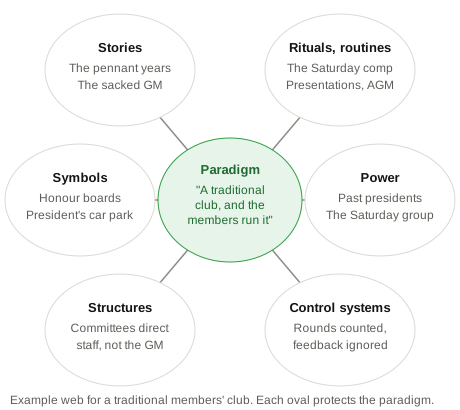
Johnson (1992) developed the cultural web to explain why strategic change fails. Six elements surround and protect the club’s paradigm (its core assumptions):
- Stories: the tales members tell (the year the club won the pennant, the GM who was sacked).
- Rituals and routines: the Saturday comp, the presentation, the AGM.
- Symbols: the honour boards, the members’ bar, reserved car parks for the president and captain.
- Power structures: who really decides (often past presidents and long-standing members, not the board).
- Organisational structures: the committees and reporting lines.
- Control systems: what is measured and rewarded, and what gets complained about.
The web is useful because it turns “culture” into things you can actually change. Remove the president’s car park, change the stories the GM tells at the AGM, and alter what the board measures.
Subcultures
Clubs rarely have one culture. Staff and members have different cultures, as do the greens crew and the kitchen, and so do the Saturday men, the midweek women, the juniors and the social members. A “culture problem” is often a clash between two subcultures that each think they are the real club.
Gender, inclusion and culture
Research on women in golf gives a sharp view of culture in practice:
- McGinnis, McQuillan and Chapple (2005) interviewed women golfers in the US and found sexism ranging from overt exclusion to the routine assumption that women are slow and don’t belong. Many persisted because they loved the game, not because the club welcomed them.
- McGinnis and Gentry (2006) found that the constraints women face (time, tee access, unwelcoming attitudes) drive them away, and that clubs can reduce them.
- Reis and Correia (2013) describe a “consented exclusion” in Portuguese golf: unequal arrangements accepted as normal by both men and women.
This matters for strategy. Women make up 31% of adult golfers in The R&A’s nine largest markets and half of those in newer formats (The R&A, 2025), and The R&A and GolfRSA run the Women in Golf Charter, which commits signatory clubs to measurable change in participation, leadership and culture. Bryanston Country Club became the first South African signatory in 2025.


Psychological safety
Edmondson (1999) found that teams learn and improve when members believe they can speak up, admit mistakes and question decisions without being punished. This is psychological safety. In a club, this decides whether a junior greenkeeper reports a chemical spill, whether bar staff tell the GM that the president is drinking after hours, and whether department heads tell the board the truth (Lesson 13). Evidence: strong research base. It has been replicated in health care, manufacturing and services.
Culture affects future plans
Culture constrains strategy in three ways:
- It filters the analysis. A club that assumes “we’re the best club in the district” will produce a SWOT that underrates its threats.
- It defines acceptability. A strategy that challenges core assumptions will lose the vote, however good it is (Lesson 5’s SAFe test).
- It resists implementation. Even after approval, staff and members slow or undo changes that cut against their assumptions (Lesson 8).
Critical view
- “Culture” is often used as a vague catch-all (“it’s just the culture here”) that avoids naming specific behaviours. Push for artefacts and evidence.
- Most culture models came from studies of companies, not volunteer member clubs, where the “culture-setters” (members) aren’t employees and can’t be managed.
- There is debate about whether managers can change culture directly, or only change the conditions (structures, symbols, rewards) and let culture follow.
Seminar questions
- Describe three artefacts at your club that contradict its espoused values. What do they tell you about underlying assumptions?
- Using the Competing Values Framework, what is your club’s dominant culture, and what culture does its strategy need?
- Is a strong clan culture an asset or a liability for a club trying to attract younger members?
Workplace task 7
Draw your club’s cultural web. Spend a Saturday morning watching: note at least two items for each of the six elements. Then write a one-sentence statement of the paradigm in the middle.
Watch
- Edgar Schein’s three levels of organisational culture (Mike Clayton)
- Building a psychologically safe workplace (Amy Edmondson, TEDxHGSE)
Sources
- Cameron and Quinn (2011), Diagnosing and Changing Organizational Culture, 3rd edition, Jossey-Bass
- Edmondson (1999), Psychological safety and learning behavior in work teams, Administrative Science Quarterly
- Johnson (1992), Managing strategic change: strategy, culture and action, Long Range Planning
- McGinnis, McQuillan and Chapple (2005), I just want to play: women, sexism, and persistence in golf, Journal of Sport and Social Issues
- McGinnis and Gentry (2006), Getting past the red tees, Journal of Sport Management
- Reis and Correia (2013), Gender inequalities in golf: a consented exclusion?, International Journal of Culture, Tourism and Hospitality Research
- Schein (2010), Organizational Culture and Leadership, 4th edition, Jossey-Bass
- GolfRSA (2025), Bryanston leads as first GolfRSA Women in Golf Charter signatory
- The R&A (2025), Over 100 million golfers in R&A markets
Draft module material for the PGA of South Africa Director of Golf certificate, for discussion. South African law applies throughout. It is general education, not legal or financial advice: Acts, regulations and codes change, so check the current version and take advice before acting on them.