
Golf Club Management
Assessment: The Club Management Diagnostic
The assignment tests whether you can use management theory to diagnose a real organisational problem and argue for a response. It is not a test of whether you can describe the theory. A good answer analyses, evaluates, synthesises and recommends.
Length: 2,500 to 3,000 words, excluding the reference list and appendices (tables and diagrams in appendices are encouraged). Weighting: suggested 60% of the module. Referencing: APA 7th or Harvard, used consistently. At least 12 sources, of which at least 6 are peer-reviewed journal articles or scholarly books. Industry and regulatory sources (GolfRSA, The R&A, King V, the Acts themselves) are welcome, alongside the scholarly sources, not in place of them. Law: South African law applies throughout.
The case: Kestrel Downs Golf Club
Kestrel Downs is fictional. It is set in Gauteng, on the edge of a fast-growing development corridor north of Johannesburg where new housing and estates are replacing smallholdings.
History and position. Founded in 1962, Kestrel Downs is an 18-hole parkland course with a 1970s clubhouse, a nine-hole practice course and a driving range. It was once regarded as one of the best courses in the province and hosted provincial championships and, in the 1990s, a Sunshine Tour event. It is a non-profit company with 1,040 members and is approved by SARS as a recreational club.
Membership.
| 2019 | 2026 | |
|---|---|---|
| Full playing members | 820 | 690 |
| Women playing members | 150 | 110 |
| Junior members | 40 | 35 |
| Social members | 30 | 205 |
| Total | 1,040 | 1,040 |
| Average age of full members | 58 | 63 |
| Annual resignations | 55 | 96 |
Total membership has held steady only because social members joined to use a new simulator lounge. Two golf estates within 20 minutes have opened since 2019 and have waiting lists. Exit surveys mention “unfriendly culture”, “can’t get a Saturday time”, “the food has gone downhill”, “I don’t feel safe in the car park after dark” and “nobody listens”. The membership is 82% white, in a district that is not.
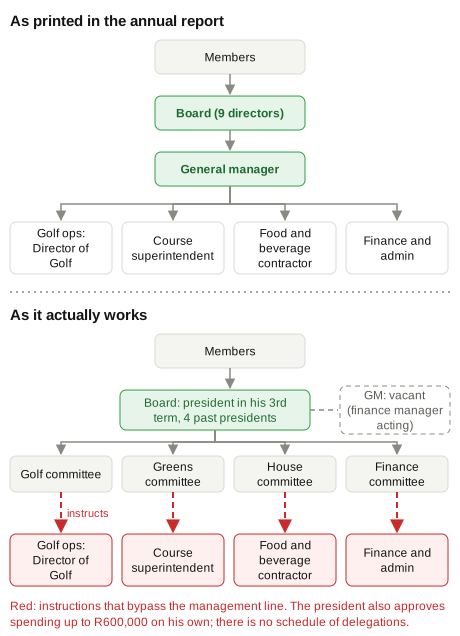
Governance. A board of nine elected directors serves two-year terms, and four of them are past presidents. The president, a retired builder, has served three terms in a row. There are no appointed or skills-based directors, no board charter and no skills matrix. Directors chair the golf, greens, house and finance committees, and each committee chair meets “their” department head weekly and gives instructions. Board meetings run for four hours, mostly on operational matters. Minutes record discussion at length but rarely record resolutions or actions. The MOI was last updated in 2011, when the club converted from a voluntary association.
Management. The club has had three general managers in five years. The latest left in July 2026, citing “interference”, and the role is being covered by the finance manager. The Director of Golf, a PGA of South Africa professional, has been at the club for 14 years. They lease the pro shop, run coaching, manage competitions and the caddie roster under a licence agreement that expires in 2027, and they report to the golf committee, not the GM. The course superintendent reports to the greens committee chair. Catering is outsourced to a contractor whose contract has no service standards. A 2025 member survey rated food and beverage 4.9 out of 10.
People and culture. Saturday morning is dominated by a long-standing men’s group. Women’s competitions are fixed on Tuesday morning. Staff describe a “them and us” atmosphere, and two bar staff have complained about abusive and racist comments from a member who is a past captain. No action was taken. Staff turnover in hospitality was 62% last year. The club has 74 employees, but no employment equity plan has been lodged since 2019. Its B-BBEE certificate has lapsed. The values statement on the clubhouse wall reads “Tradition, Respect, Excellence”.
Systems and processes. The club installed a new club management system in 2024 but uses only the membership and billing modules. The tee sheet runs in a separate booking system, the bar uses its own point of sale, and corporate days are booked by phone and email. There are SOPs for the bar but none for events, course closures or incident reporting. In March 2026 a function was double-booked with a corporate golf day, and 140 guests arrived for a room that held 90. There is no schedule of delegations: the president has approved purchases of up to R600,000 on his own.
Finance. Revenue was R48 million in 2025-26, of which subscriptions were 55%. The operating result was a surplus of R1.6 million before depreciation and a deficit of R2.9 million after it. Wages are 52% of revenue. Electricity and diesel cost R1.9 million. The capital reserve holds R4.5 million against a capital works plan (last updated in 2019) that estimates R55 million of renewals in ten years, including a R32 million clubhouse refurbishment and a R14 million irrigation system that is now 31 years old.
Risk and compliance.
- In January 2026 a golf cart rolled on the wet slope beside the 7th tee. The member was bruised; the incident was not recorded.
- In February 2026 a fourball was robbed at gunpoint on the 14th, next to a damaged section of the perimeter fence that had been reported twice.
- The lightning siren failed during a November storm. Staff cleared the course by cart, and some members kept playing.
- In May 2026 an office volunteer emailed the full member list, with ID numbers, phone numbers and addresses, to all members in the “To” field. The club did not report it to the Information Regulator.
- The junior programme has no child safeguarding policy, and two volunteer coaches have never been checked against the National Register for Sex Offenders.
- A provincial liquor inspector noted that non-members were paying for drinks at the bar during corporate days.
- There is no risk register, and no health and safety representatives have been appointed.
Environment. The course is irrigated from municipal water and a dam. During the 2024-25 restrictions, the club stopped irrigating fairways for six weeks. The municipality has offered treated effluent from a wastewater works 2 km away, at a connection cost of R7 million, and a borehole contractor has quoted for three boreholes (pending authorisation under the National Water Act). A solar company has proposed a power purchase agreement for carport solar with batteries. The board has deferred all three decisions twice.
Opportunities. The growth corridor is expected to add 40,000 residents within ten years, many of them young families. The municipality, which leases the club the land under the practice course, has asked whether the club would partner on a community junior and schools programme, and has said its B-BBEE status will count when the lease is renewed. The Director of Golf has proposed a nine-hole twilight membership. A neighbouring developer has approached the board informally about buying the practice course lease.
The task
Write a management diagnostic report to the board of Kestrel Downs. In it you must:
- Diagnose the club’s situation using relevant management theory. Identify the root causes, not only the symptoms.
- Analyse the environment using PESTLE and SWOT (you may add five forces, TOWS or stakeholder analysis).
- Evaluate the club’s governance, structure and culture.
- Identify the major management risks, including statutory and safety risks under South African law.
- Recommend priorities. You can’t fix everything at once, so choose and justify five or six.
- Produce a high-level implementation framework: sequence, owners, resources, measures and how progress will be reported to the board.
- Justify your recommendations with credible academic and industry sources.
Suggested structure
| Section | Approximate words |
|---|---|
| Executive summary (for a busy board) | 250 |
| Introduction and approach | 150 |
| Environmental analysis (PESTLE, SWOT; tables in appendix) | 450 |
| Governance and structure diagnosis | 450 |
| Culture, transformation and change readiness | 400 |
| Systems, processes and risk | 450 |
| Priorities and recommendations | 450 |
| Implementation framework | 300 |
| Conclusion | 100 |
| Total | 3,000 |
Marking rubric
| Criterion | Weight | High distinction (85+) | Credit (65 to 74) | Fail (under 50) |
|---|---|---|---|---|
| Diagnosis and use of theory (LO1 to LO3) | 25% | Theory chosen deliberately, applied to case evidence, root causes separated from symptoms, limits of theory acknowledged | Relevant theory applied correctly, some link to root causes | Theory described rather than applied, or missing |
| Environmental analysis (LO1) | 15% | PESTLE and SWOT evidence-based, prioritised and converted into strategic options (e.g. TOWS) | Complete and accurate, some prioritisation | Generic lists with no evidence or prioritisation |
| Governance, structure and culture evaluation (LO2, LO3) | 15% | Clear governance/management analysis using research (e.g. archetypes, board theories, King V); culture and transformation diagnosed with a model and linked to change readiness | Sound evaluation with some research | Descriptive or opinion-based |
| Risk and compliance (LO5, LO6) | 10% | Risks prioritised with reasoning; legal duties correctly identified under South African law; urgent breaches separated from longer-term risks; controls proposed | Main risks identified, some controls | Risks listed without analysis, or legal errors |
| Recommendations and implementation (LO4, LO7) | 20% | Prioritised, justified, feasible and acceptable (SAFe); implementation framework with sequence, owners, resources and measures | Reasonable recommendations, partial implementation detail | Unprioritised wish list or no implementation |
| Use of sources | 10% | 12+ sources, strong peer-reviewed base, evidence strength judged, accurate referencing | Adequate sources, mostly accurate referencing | Few or weak sources, poor referencing |
| Communication | 5% | Board-ready: clear executive summary, logical structure, concise | Clear, minor issues | Hard to follow |
Hints from the markers
- The case contains more problems than you can fix. The best reports find the two or three root causes behind most of the symptoms. Is the poor food a catering problem, a contract management problem, or a governance problem?
- Notice what the membership figures hide. A stable total masks a falling core.
- Be explicit about sequence. Some fixes enable others (you probably can’t recruit a strong GM until the governance problem that drove the last three away is solved).
- Some legal problems can’t wait for the strategic plan: the unreported POPIA security compromise, the harassment complaint, safeguarding checks, health and safety representatives, and the liquor licence conditions. Say what must happen in the first 30 days.
- Transformation is part of the strategy, not an appendix. Connect it to membership, the municipal lease, staff, the board and the culture.
- Say how strong your evidence is. A recommendation based on a practitioner framework is fine, but say so.
Draft module material for the PGA of South Africa Director of Golf certificate, for discussion. South African law applies throughout. It is general education, not legal or financial advice: Acts, regulations and codes change, so check the current version and take advice before acting on them.