
Golf Club Management
Lesson 14: Technology, data and AI in club management
Goal: evaluate a club’s technology and data systems, design management information that supports decisions, and assess where AI can help and where it creates risk.
The club technology stack
A modern club runs on several connected systems:
- Club management system (CMS): membership records, billing and subscriptions, point of sale, accounting, and member communications. Jonas Club Software is one of the most widely used, serving more than 2,000 clubs across many countries, with modules for tee sheets, food and beverage, events, CRM and accounting. Golf Genius and several South African systems are alternatives, and many clubs run separate tee sheet, point of sale and accounting products.
- Tee sheet and booking: online booking, competition entry, visitor bookings, and in some clubs dynamic pricing.
- Handicapping and scoring: the World Handicap System (WHS), run by The R&A and USGA since 2020 and updated in 2024, is administered nationally. In South Africa, Handicaps Network Africa (HNA) provides the official handicap system on behalf of the South African Golf Association, used by more than 140,000 golfers. In early 2026 HNA migrated to a new platform built by DotGolf (owned by The R&A and Golf New Zealand), which is also used in England, Scotland, Ireland, Japan and New Zealand. Clubs feed competition scores into HNA, and members post their own social rounds through the HNA app.
- Course systems: irrigation control, weather stations, soil moisture sensors, machinery tracking.
- Workforce: rostering, payroll, training records.
The main management problem is integration. When systems don’t talk to each other, staff re-key data, and the club can’t answer simple questions like “which members haven’t played in six months?” before they resign.
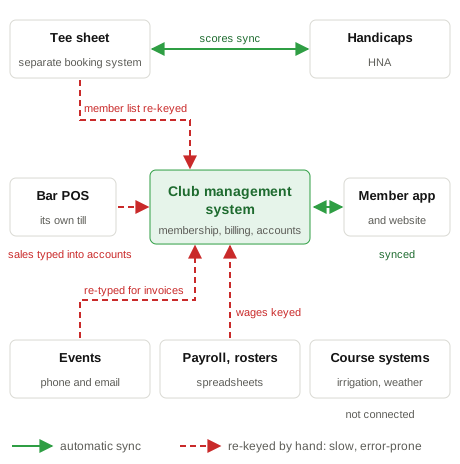
Data capture
Every interaction can create data: a booking, a round, a score, a bar purchase, an event, a complaint, a course closure. Good data capture means:
- capturing data once, at the source, in the system of record;
- consistent definitions (what counts as an “active” member?);
- a named owner for each data set;
- quality checks (duplicate members, missing emails);
- collecting only what the club needs, which is also a legal requirement (POPIA’s minimality condition: personal information must be adequate, relevant and not excessive for its purpose).
From data to management information
Data becomes management information when it answers a decision question. DeLone and McLean’s (2003) information systems success model says a system succeeds through the quality of the system, its information and its service, which drives its use and user satisfaction, which then create net benefits. Davis’s (1989) technology acceptance model adds that staff use a system when they believe it’s useful and easy to use. Both are well tested. Evidence: strong research base.
Useful club dashboards include:
| Decision | Information |
|---|---|
| Is the course full when it should be? | Tee sheet utilisation by day and time; no-show rate |
| Who is at risk of leaving? | Rounds and spend per member over 12 months; members with a sharp drop |
| Is hospitality paying its way? | Covers, average spend, gross profit, wage cost per cover |
| Are we meeting the strategy? | The balanced scorecard (Lesson 5), updated monthly |
AI in club management
What the research shows (early but strong evidence):
- Brynjolfsson, Li and Raymond (2025) studied 5,179 customer support agents using a generative AI assistant. Productivity rose by about 14% on average and by about 34% for novice and low-skilled workers, with little gain for the most experienced.
- Dell’Acqua et al. (2023) ran a field experiment with 758 Boston Consulting Group consultants. On tasks inside AI’s capability (“the jagged frontier”), AI users finished more tasks, faster and at higher quality. On a task just outside it, they were less likely to get the right answer than people working without AI, because they trusted plausible but wrong output.
The management lesson: AI helps most with well-defined, text-heavy tasks and with less experienced staff, and it needs human checking where accuracy matters.
Likely club uses:
- drafting member communications, job ads, SOPs and board papers;
- summarising meeting notes into draft minutes and action lists (Lesson 13), to be checked by the secretary;
- answering routine member questions (bookings, dress code, course status) through a website assistant;
- forecasting tee sheet demand and staffing, and flagging members at risk of leaving;
- analysing member survey comments;
- course management: weather-based irrigation scheduling and turf disease prediction.
Risks and controls:
- Accuracy: AI output can be confidently wrong. A rules decision or a legal notice drafted by AI must be checked by someone qualified. South Africa has its own cautionary tale: the government’s draft National AI Policy, published in April 2026, was withdrawn within weeks after it was found that at least 10% of its academic references did not exist, apparently because AI had been used to write it without checking.
- Privacy: POPIA’s conditions apply to anything the club puts into an AI tool. Section 72 restricts sending personal information outside South Africa (where most AI services run) unless the recipient is bound by adequate data protection law or a binding agreement, or the person consents. Section 71 gives people the right not to be subject to decisions with legal effect based solely on automated profiling. Use business accounts with clear data terms, keep members’ personal information out of free public AI tools, and do a privacy impact assessment first.
- Bias and fairness: a model that flags “low value” members, or screens job applicants, can discriminate.
- Governance: King V expects governing bodies to oversee technology, AI and cyber risk. South Africa’s National AI Policy Framework (Department of Communications and Digital Technologies, 2024) sets out national principles, but a final national AI policy is still being developed. Until it arrives, the NIST AI Risk Management Framework is a sound international reference. Its four functions are govern, map, measure and manage.
A sensible first step for a club is a one-page AI use policy: which tools are approved, what data can never go into them, who checks output before it’s used, and who is accountable.
Critical view
- Technology projects in clubs fail for the reasons in Lesson 10: underestimated time, poor data migration, and too little training. The software is rarely the problem.
- Vendors tend to oversell AI. Ask for evidence from clubs like yours, and pilot before committing.
- More data doesn’t mean better decisions if nobody owns the question being asked.
Seminar questions
- Your club uses one system for membership, another for the tee sheet and a third for the bar. What does that cost, and how would you make the case for integration?
- Which club tasks are inside AI’s “jagged frontier” today, and which are outside it?
- Should a club use AI to identify members likely to resign? What are the privacy and ethical issues?
Workplace task 14
List every system your club uses, what data each holds, and how they connect (draw the links). Mark where data is re-keyed by hand. Then draft a one-page AI use policy for your club that names who is accountable, which tools are approved, what data may never go into them, and who checks the output.
Watch
- How the World Handicap System works (Open Stance Golf)
- Navigating the jagged technological frontier (Ethan Mollick, Stanford Digital Economy Lab)
Sources
- Brynjolfsson, Li and Raymond (2025), Generative AI at work, Quarterly Journal of Economics
- Davis (1989), Perceived usefulness, perceived ease of use, and user acceptance of information technology, MIS Quarterly
- Dell’Acqua et al. (2023), Navigating the jagged technological frontier, Harvard Business School Working Paper 24-013
- DeLone and McLean (2003), The DeLone and McLean model of information systems success: a ten-year update, Journal of Management Information Systems
- NIST (2023), Artificial Intelligence Risk Management Framework (AI RMF 1.0)
- Information Regulator, POPIA
- OECD.AI, South Africa National Artificial Intelligence Policy Framework; DLA Piper (2026), The withdrawal of South Africa’s draft AI policy
- GolfRSA (2026), HNA update: migrated handicap stable; Handicaps Network Africa
- Jonas Club Software
- Clyde and Co (2025), King V Code enhances principles regarding AI governance and cyber risks
Draft module material for the PGA of South Africa Director of Golf certificate, for discussion. South African law applies throughout. It is general education, not legal or financial advice: Acts, regulations and codes change, so check the current version and take advice before acting on them.